
May 19, 2026
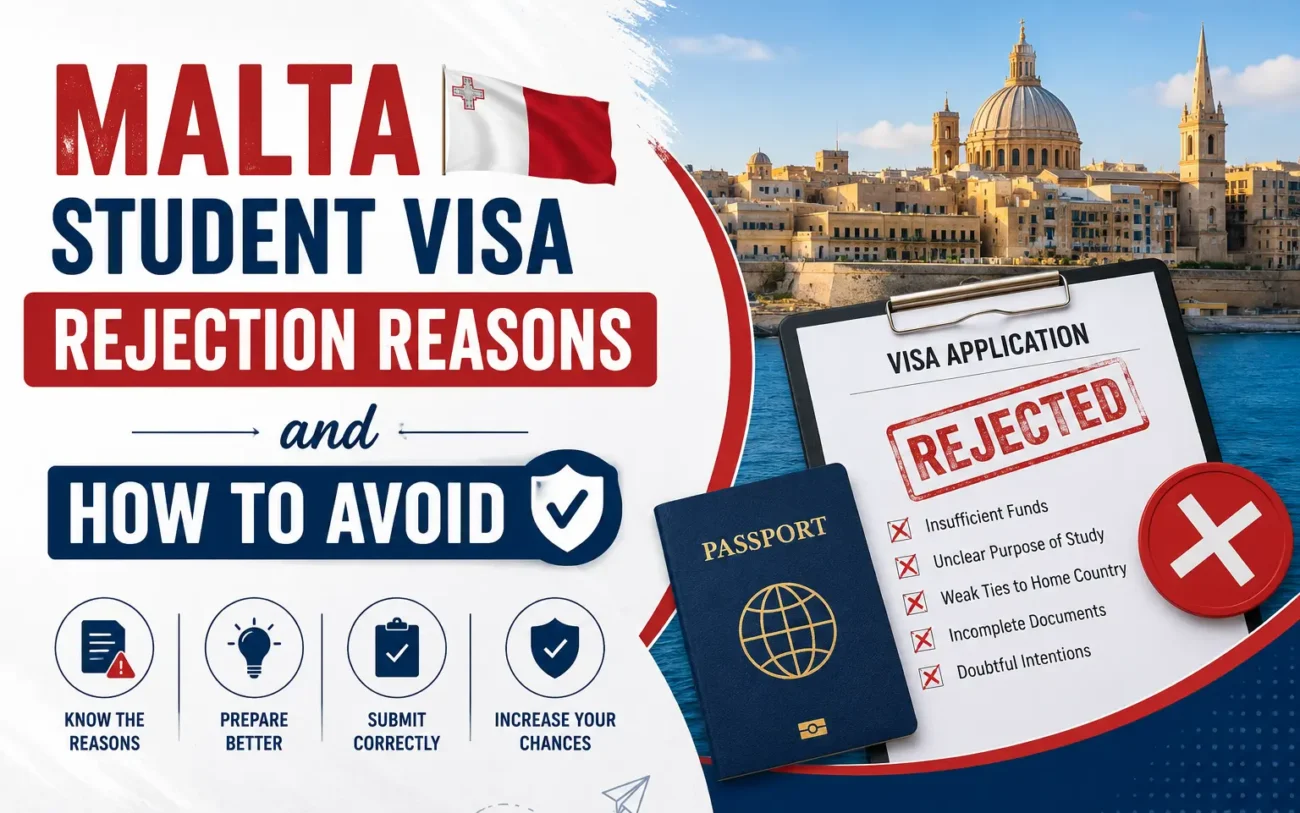
Malta Student Visa Rejection Reasons and How to Avoid
You spent weeks shortlisting universities, filled every form carefully, gathered your documents — and then came the rejection.
No clear explanation. No second chance. Just a stamp that says no.
Malta student visa rejections are more common than most consultancies admit. And the frustrating part? Most rejections happen not because students are unqualified, but because of small, fixable mistakes that quietly destroy otherwise strong applications.
Every blog out there covers the obvious stuff — missing documents, insufficient funds, weak SOP. You’ve already read those. This guide goes further. It covers the mistakes that still get overlooked, what visa officers are actually looking for, what happens after a rejection, and how to protect yourself after you arrive.
First, Understand How Visa Officers Read Your File
Before listing the mistakes, it helps to understand the mindset on the other side of the desk.
A Malta visa officer does not read your file in isolation. They read it as a story. Every document is a chapter. If the chapters are inconsistent — your bank statement shows one thing, your sponsor letter says another, your SOP points in a third direction — the story falls apart.
The goal of every document you submit is not just to satisfy a checklist. It is to build a coherent, believable narrative: this student has a genuine reason to study in Malta, the financial ability to do it, and a clear reason to return home when it is over.
If any part of that narrative creates doubt, the entire file suffers.
Mistake 1: Incomplete or Poorly Scanned Documents (The Basics, Done Wrong)
It is not just about having the right documents. It is about how those documents look when the officer opens them.
Common submission errors that are rarely discussed:
- Scanned pages at an angle, with shadows cutting across text
- PDF files where pages are in the wrong order
- Colour scans submitted where black-and-white originals were required, or vice versa
- Files named things like "scan001.pdf" instead of "Passport_[YourName].pdf" — which makes the officer work harder to match documents
- Documents emailed or uploaded in formats not accepted by the specific visa processing center (some reject .jpg; they want .pdf)
What to do instead:
Scan every page flat, check that all text is readable, and rename files clearly before uploading. Treat the file you submit the way you would treat a job application going to a company you really want to work for.
Mistake 2: The Bank Statement Trap — What "Sufficient Funds" Actually Means
Every guide tells you to show enough funds. Very few explain what “enough” looks like in practice, or what patterns in your bank statement send red flags.
Malta typically requires evidence of around €11,000–€15,000 available for a full academic year, or approximately €48 per day for shorter stays. But the number is only half the story.
The patterns that trigger suspicion:
- A large deposit landing in your account within 2–4 weeks of your application date
- A balance that is unusually high compared to the previous 5–6 months
- Frequent large transfers in and out, which suggest the money belongs to someone else
- Statements that only cover one month instead of the required three to six
What actually works:
Submit bank statements for the last three to six months that show a consistent, healthy balance — not a sudden spike. If your funds come from a family member or sponsor, include a clear sponsor letter explaining the relationship, showing their income, and stating explicitly that they are covering your education costs. A sponsor letter without supporting income documents is almost worthless.
One detail almost no blog mentions: If you are receiving a scholarship, include the official award letter. If you have an education loan sanctioned, include the sanction letter. These are supporting evidence, not replacements for bank statements — but they significantly strengthen your financial narrative.
Mistake 3: The Statement of Purpose — Phrases That Kill Applications
A weak SOP is a well-known reason for rejection. But what exactly makes an SOP weak?
It is not just vague writing. It is specific phrases and patterns that signal to a visa officer that the statement was written without genuine thought.
Phrases that undermine your SOP:
- Malta is a beautiful country with rich culture" — sounds like a travel brochure, not academic intent
- I want to broaden my horizons" — meaningless without context
- This course will help me grow professionally" — says nothing specific
- I plan to return to my country and contribute to its development" — so generic it reads as a template
What a strong SOP actually requires:
- A specific explanation of why this course at this institution — what does it offer that a university in your home country cannot?
- A clear academic progression — how does what you studied before connect logically to what you want to study now?
- A concrete career goal with a realistic plan for using this degree once you are back home
- Personal voice — write it the way you would explain your choice to a professor, not the way you imagine a visa officer wants to hear it
The golden test: Read your SOP out loud. If it sounds like it could have been written by anyone — any student, from any country, applying to any programme — rewrite it.
Mistake 4: Course Mismatch and Unexplained Academic Gaps
Visa officers pay close attention to whether your chosen course makes sense given your educational background. A jump from a Bachelor’s in Accounting to a Master’s in Health Sciences, with no explanation, raises questions about study intent.
Common academic red flags:
- Shifting to a completely unrelated field without any explanation in the SOP
- Study gaps of one year or more with no supporting documentation
- Applying for a qualification lower than what you already hold (e.g., applying for a Bachelor's when you already have a Master's)
How to handle gaps and course changes:
If you have a gap, do not hide it. A gap year that is explained with supporting evidence (medical documents, work experience, family circumstances) is far less damaging than a gap that appears to be concealed. Address it directly and briefly in your SOP, then provide whatever documentation supports your explanation.
If you are changing fields, explain the career logic. Show how your previous education gives you a foundation that makes the new course a natural next step, even if the subjects differ.
Mistake 5: Weak Ties to Your Home Country (The Hidden Deal-Breaker)
This is the mistake that is mentioned least — and causes the most rejections.
A student visa is a temporary permission. It is granted on the understanding that the student will return home after completing their studies. If your file does not establish a convincing reason to return, the application weakens significantly.
What visa officers look for:
- Family ties (especially dependants or parents who rely on you)
- Property ownership or family assets in your home country
- A job offer or business connection that will resume after graduation
- A clear career that is more viable at home than abroad
What many applicants forget to include:
- A letter from an employer confirming that you are on study leave and will return
- Documentation of family property or land ownership
- Evidence of ongoing family responsibilities at home
You do not need to include all of these. But you do need at least something that shows your life and future plans are anchored at home, not floating toward permanent residency in Malta.
Mistake 6: The Digital Application Errors Nobody Warns You About
This entire category is missing from every competitor blog — and it costs real applicants real rejections.
Common digital and portal mistakes:
- Entering your name in a different format on your application form versus your passport (e.g., "Mohammed" vs "Muhammad" — even a spelling variation can create a mismatch)
- Using a personal email address that looks unprofessional, and then missing follow-up emails because they land in spam
- Uploading documents at a file size that exceeds the portal's limit, causing silent upload failures
- Not saving a copy of the submitted application — if questions arise later, you have no record
- Submitting and then making a separate enquiry that contradicts information in your application
What to do:
Before submission, compare every name, date, and reference number across your passport, application form, acceptance letter, and bank statements. Any discrepancy is a problem. After submission, set up a folder in your email specifically for Malta visa correspondence and check it regularly.
Mistake 7: Health Insurance — The "Right Policy" Problem
Most tell you to get health insurance. Very few specify what “the right policy” actually means.
For a Malta student visa, you need health insurance that covers the entire Schengen Area, not just Malta. It must provide a minimum of €30,000 in coverage (with many advisors recommending €100,000 or more) for medical emergencies, hospitalisation, and repatriation.
The mistakes that lead to rejection:
- Purchasing a policy that covers only Malta but not the broader Schengen Area
- A policy that covers fewer than the required number of days (even a one-day shortfall can be a problem)
- Policies that exclude pre-existing conditions without declaring them
- Buying insurance from a provider that is not recognised by Maltese authorities
How to get it right:
Purchase a policy explicitly marketed for Schengen visa purposes. Read the policy document before buying, not after. Confirm that the coverage dates fully overlap with your intended stay — not just the initial visa period.
Mistake 8: Applying Too Late (And Misunderstanding What "Early" Means)
“Apply early” is standard advice. What most guides don’t say is what early actually means in practice.
The Malta student visa process can take six to twelve weeks, sometimes longer during peak intake seasons (September and February intakes see the highest volumes). Factor in the time to gather documents, get translations certified, and book an appointment at the relevant visa application center.
A realistic timeline working backwards from a September intake:
- Offer letter received: April
- Begin document gathering: April (immediately)
- Book visa appointment: May
- Submit visa application: late May to early June
- Expected decision: late July to mid-August
- Arrive in Malta: late August
Starting in July for a September intake is too late. Starting in August is a near-certain problem.
What Happens After a Rejection? (The Part Every Blog Skips)
Almost no guide covers this — and yet many students face it.
If your Malta student visa is rejected, you have a few options:
You are entitled to ask why your application was refused. The decision letter may include a reason, but if it is vague, you can submit a formal request for clarification through the relevant embassy or visa application center.
If the rejection reason is fixable — a missing document, insufficient funds at the time, a weak SOP — gather the correct materials and submit a fresh application. There is no automatic ban on reapplying after a Malta student visa rejection.
Do not reapply with the same file. A rejection means something in that file created doubt. Resubmitting the same documents is likely to produce the same result.
A rejection close to an intake date may mean missing that intake. Reapply for the next intake with sufficient lead time rather than rushing a second application.
What Happens After You Arrive? Post-Arrival Compliance Mistakes
students who successfully get their visa and arrive in Malta, then unknowingly put their status at risk.
Common post-arrival mistakes:
- Not registering with local authorities within the required timeframe after arrival
- Missing too many classes — attendance is tracked, and poor attendance can affect your residence status
- Taking on more work hours than your student visa permits
- Not renewing your residence permit before it expires
- Changing your course or institution without informing the authorities
Why this matters:
A student visa is not just a permission to enter Malta. It comes with conditions that must be maintained throughout your stay. Violating those conditions — even unintentionally — can affect future visa applications, your ability to complete your studies, and potentially result in removal.
Keep a record of your attendance, track your residence permit expiry date, and speak to your institution’s student services team if anything in your circumstances changes.
A Pre-Submission Checklist: Your Final Review Before Clicking Submit
Before submitting your Malta student visa application, confirm the following:
Documents
- Valid passport with at least 3 months validity beyond your intended departure from Malta
- Completed visa application form — every section filled, signed
- Official letter of acceptance from your Maltese institution
- Confirmed accommodation details (address, lease agreement or university accommodation letter)
- Passport-size photographs meeting Schengen specifications
Finances
- Bank statements for the last 3–6 months showing consistent funds
- Sponsor letter with income proof (if applicable)
- Scholarship or education loan documents (if applicable)
- No unexplained large deposits in the months before application
Insurance
- Schengen-compliant health insurance
- Minimum €30,000 coverage (€100,000 recommended)
- Policy valid for the full duration of your intended stay
Statement of Purpose
- Specific reason for choosing Malta and your institution
- Clear academic and career progression logic
- No template phrases or generic language
- Addresses any gaps or subject changes
Home Ties
- Evidence of family, property, or employment ties to your home country
Digital Check
- Name matches exactly across all documents
- Files are clear, correctly named, and within upload size limits
- You have copies of everything submitted
Final Word
A Malta student visa application is not a test of how many documents you can gather. It is a test of how convincingly you can tell the story of a genuine, prepared, goal-oriented student who plans to study, return home, and build something with what they learned.
Every document is part of that story. Every number in your bank statement. Every line in your SOP. Every date on your insurance policy.
Take the time to make the story coherent — and then give yourself enough time for the process to run its course.
Malta is genuinely worth it. Don’t let a preventable mistake stand between you and being there.